Hyperloop One Facts & FAQ
Founded: June 2014
Employees: 280+ (as of July 2017)
Vision: Reinvent transportation to eliminate the barriers of distance and time
Mission: Deliver fast, direct, autonomous, sustainable transportation at scale, beginning with three production systems in service by 2021
Locations: Innovation Campus in Los Angeles, CA; Apex Test & Safety Site in North Las Vegas, NV; Metalworks manufacturing facility in North Las Vegas, NV; Regional Offices in Dubai and London.
Leadership Team: Co-founder and Executive Chairman Shervin Pishevar, CEO Rob Lloyd, Co-founder and President of Engineering Josh Giegel, Chief Operating Officer and Chief Financial Officer Brent Callinicos, General Counsel Marvin Ammori, SVP Field Operations Nick Earle, SVP Talent Operations Ramiro Medina, SVP Systems Development Doug Chey.
Total Raised: $160 million
Key Investors: DP World, Sherpa Capital, 137 Ventures, Caspian VC, Formation 8, SNCF, GE Ventures, Zhen Fund, Fast Digital.
Key Partnerships: Parsons, ARUP, DP World, AECOM, Ramboll, McKinsey, KPMG, FS Links, Systra, BIG, SNCF, GE, Deutsche Bahn, PA Consulting.
Board of Directors: Shervin Pishevar (Sherpa Capital), Rob Lloyd, Josh Giegel, Joe Lonsdale (8 VC), Justin Fishner-Wolfson (137 Ventures), Peter Diamandis (X Prize Foundation), Jim Messina (Messina Group), Sultan Ahmed Bin Sulayem (DP World), Ziyavudin Magomedov (Summa Group), Emily White (Adviser)
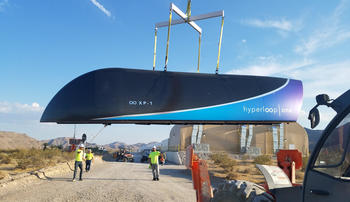
What is Hyperloop? Hyperloop is a new mode of transportation that moves freight and people quickly, safely, on-demand and direct from origin to destination. Passengers or cargo are loaded into the Hyperloop vehicle and accelerate gradually via electric propulsion through a low-pressure tube. The vehicle quickly lifts above the track using magnetic levitation and glides at airline speeds for long distances due to ultra-low aerodynamic drag. Hyperloop systems will be built on columns or tunneled below ground to avoid dangerous grade crossings and wildlife. It’s fully autonomous and enclosed, eliminating pilot error and weather hazards. It’s safe and clean, with no direct carbon emissions.
What is Hyperloop One? We’re a privately-held company out to reinvent transportation to eliminate the barriers of time and distance and unlock vast economic opportunities. Our mission is to have three systems in operation by 2021 that validate our ability to design, finance and build a safe, revolutionary transportation technology that scales.
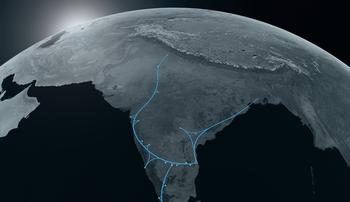
What is the Hyperloop One Global Challenge? It’s our worldwide competition to find the best Hyperloop routes. The response has been great: More than 2,600 teams registered for the Challenge. We’ve had applications from governments, regional groups, universities and private companies in more than 100 countries. The field is now narrowed down to 35 semi-finalists from every continent (except Antarctica). Finalists will be announced in 2017.
Why do we need a Hyperloop? A growing global economy requires faster, cheaper, safer and more efficient transportation modes. Our roads, airports, and ports are congested. We haven’t had a new form of transport in 100 years, and we’re due for one, especially one that is ultra-fast, on-demand, direct, emission-free, energy efficient, quiet and has a smaller footprint than other high-speed transport modes. Hyperloop is additive to existing forms of transportation and will integrate seamlessly with the transport ecosystem.
Why now? People have been dreaming of high-speed travel in tubes, including in vacuum, for more than a century. And many of the technologies we’re combining have been around for a while: linear electric motors, maglev, vacuum pumps. The catalyst was SpaceX CEO Elon Musk releasing his white paper in the summer of 2013. Musk presented a brilliant system architecture. We started with his basic designs and, after considering how we could provide value to the world as a whole, added a focus on moving freight in addition to passengers. We then started from the bottom-up to innovate on the technology and cost elements to deliver real value.
Is Elon Musk an investor or affiliated with Hyperloop One? No, but we share the same goal of wanting to see Hyperloop become a reality worldwide. Hyperloop One is proud to sponsor several teams in SpaceX’s Hyperloop Pod Competition.
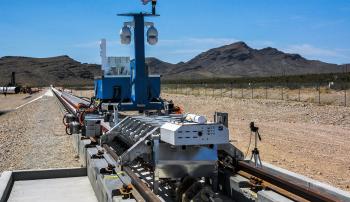
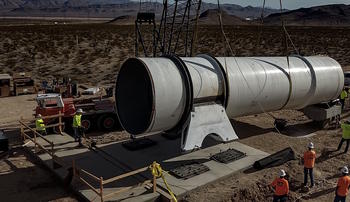
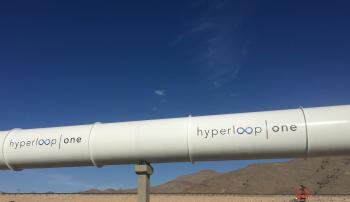
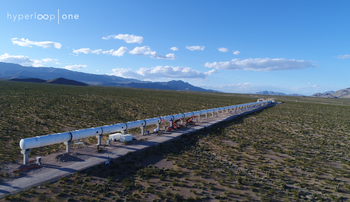
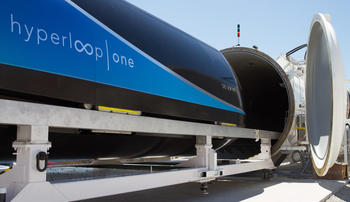
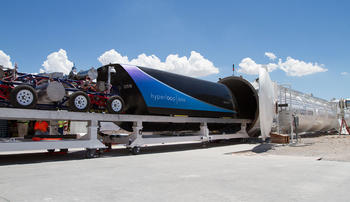
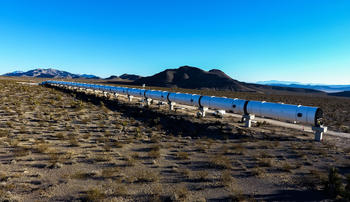
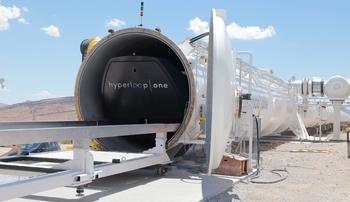
Where will the first Hyperloop get built? There are numerous opportunities both in and outside the U.S. We have constructed a full-system test development track, DevLoop, in the Nevada desert, combining the pod, tube, vacuum, levitation, propulsion, and braking. In May 2017, we successfully completed the first full system, self-powered Hyperloop test, which was the first time that anyone had integrated all of the components of a Hyperloop in a complete system at scale. We are conducting a series of additional tests and, and once we successfully validate our technology, we will progress toward building proof of operations facilities around the world to obtain international safety and certification standards. Our goal is to have three systems in service by 2021.
Are you building a Hyperloop between San Francisco and Los Angeles? That route was the inspiration for Elon Musk’s original white paper, but it is not in our immediate plans.
How much will Hyperloop One systems cost to build and operate? Capital and operating costs will range widely based on route and application (passenger, cargo) but third parties have concluded that the capital and operational costs of a Hyperloop system is two-thirds that of high-speed rail. Our FS Links study for a 500-kilometer route connecting Helsinki and Stockholm showed a capital cost of 38 million euros per km, which is on the higher side of what we think other systems would cost. That is still quite competitive with high-speed rail and that route includes a 3 billion-euro tunnel under the Baltic Sea that would be the world’s longest.
How much will tickets cost? Difficult to say as it will depend greatly on the route, but the goal is to make it affordable for everyone. For example, our projections for routes on mainland Finland and Sweden puts the ticket price at around 18 euros.
How fast is a Hyperloop? We estimate that the top speed for a passenger vehicle or light cargo will be 670 miles per hour or 1080 kilometers per hour. That is 2-3 times faster than high-speed rail and magnetic levitation trains, and 10-15 times faster than traditional rail. The average speed vehicles will travel vary based on the route and customer requirements.
You’re talking about going over 1,000km/h (600 mph) inside a tube. Is Hyperloop safe? The Hyperloop is designed to be inherently safer and more reliable than maglev or high-speed rail. We have no at-grade crossings (by far the leading risk posed by trains), so there are no interactions with other forms of transport or wildlife. We are fully autonomous, so there is no driver related error. We are immune from most weather events. We will have multiple emergency braking techniques, triggering an immediate braking of the vehicle. Vehicles will have a full suite of life support systems, and we have the ability to re-pressurize the tube if needed. Safety is the number-one advantage that the Hyperloop system provides and in our design and engineering efforts it takes precedence above everything. We strive to surpass the safety of all existing transport systems. Additionally, we are building a dedicated safety team to work with authorities to define and implement best practice protocols.
What will it feel like riding in the Hyperloop? Although Hyperloop will be fast, the systems we are building will accelerate with the same tolerable G forces as that of taking off in a Boeing 747. With Hyperloop you will be accelerating and decelerating gradually and, depending on the route, we will incorporate banking into our designs to eliminate G forces even more. It will be as smooth as riding an elevator. And there’s no turbulence.
Won’t it be scary being inside that little pod in a tube with no windows? Maybe for some, but most people have gotten pretty used to flying 500 mph at 30,000 feet in an aluminum tube no wider than 8 meters. We can use music, lighting and high-definition screens to give people a greater sense of comfort. Our design partners have also come up with some cool solutions that would let you see outside the vehicle as it travels.
What about earthquakes? Our support structures will incorporate isolators and dampers to minimize response to seismic vibrations. Hyperloop One is also collaborating with world leaders in earthquake alert systems.
What happens if there's a sudden breach in the tube? The increased drag due to air resistance will slow the pod down. We can section off parts of the route and re-pressurize that section in the case of emergency. Every pod will have emergency exits if needed but mostly pods will glide safely to the next portal (station) or egress point.
How is Hyperloop going to get certified by safety agencies and regulators? As with any new transport infrastructure, there will be regulatory hurdles to overcome. We believe that Hyperloop is a new mode of transportation and so will require a fresh approach to regulation. We’ve already begun the early stages of the certification process and look forward to continuing our work with regulators to meet existing regulations where appropriate and create new ones where needed.
Should pregnant women and people who experience motion sickness avoid riding on a Hyperloop? People should take the same safety precautions that they do when traveling by plane. Hyperloop will be safe for everyone.
Is there a height, age or weight requirement for riding a Hyperloop? As of now, there are no specific restrictions for travel on Hyperloop. The passenger experience will be extremely smooth and free of all turbulence. We are absolutely grandma friendly, child-friendly, and pet-friendly.
How is Hyperloop different from high-speed trains? There are four key differences. It’s faster, as in two to three times faster than the fastest high-speed rail. It’s on-demand and direct. Trains follow a schedule and typically have multiple stops. Hyperloop leaves when you’re ready to go, and pods can depart up to several times per minute and can transport passengers and cargo direct to their destination with no stops along the way. It’s environmentally friendly, with a smaller civil engineering footprint, more efficient energy consumption and no direct emissions or noise. It’s less expensive and different technology: High-speed rail and maglev trains require power along the entire track. As a result, the track costs more to build and more to operate. Hyperloop One achieves better performance for less cost.
How confident are you that your technology will work? To validate our technology, we have built a full-scale Hyperloop test system in the Nevada Desert. In May 2017, we successfully completed the first full system, self-powered Hyperloop test, which was the first time that anyone had integrated all of the components of a Hyperloop in a complete system at scale. We are continuing testing throughout the summer in 2017 to go farther and faster. Having our own test platform allows us to optimize across all the systems, while gaining experience and valuable insights. The work and testing completed at DevLoop substantially reduces the technical risk which will help us to progress toward building proof of operations facilities around the world.
What kind of motor do you use? We have developed a proprietary electric propulsion system which was tested first in May 2016 in an open-air propulsion test and again in May 2017 in our full-systems test. We are continuing to refine our motor and electronics to increase speed, power and efficiency and reduce cost based on what we have learned from testing.
How does the motor work? Linear electric motors produce motion in a straight line rather than in a rotational motion. In a traditional motor, the rotor (rotating part) spins inside the stator (static part), or vice-versa; in a linear motor, the stator is unwrapped and laid out flat, and the "rotor" moves past it in a straight line. In our case, the stators are installed along the track where we need acceleration. We add power to the stators, which produces electromagnetic currents that interact with the “rotor” elements underneath the vehicle to create propulsion. The rotor and stator never touch.
Where will Hyperloop One get its power? We’re energy-agnostic. Our system can draw power from whichever energy sources are available along the route. If that means solar and wind, then the entire system is 100% carbon free.
How wide is a Hyperloop One tube? We’re planning on offering different size tubes for cargo and passengers. Just as there are sports cars, sedan, minivans, SUVs, and pickup trucks, we are working on a suite of products to meet every demand.
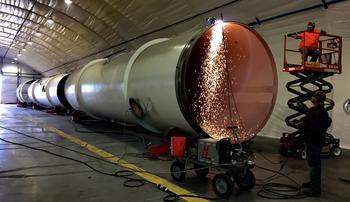
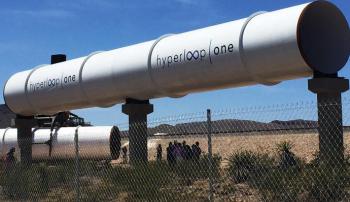
Why are the tubes made of steel? Aren't other designs lighter or more efficient? Steel was selected for our development loop due to ease of use and availability. By using solid steel for tubes, we believe that production design will be more efficient. We are looking at other materials and configurations that could provide dramatically lower cost and similar or better performance.
Why keep the tube at low-pressure and not at a perfect vacuum? We’re aiming for 100 pascals (Pa) or about one one-thousandth of the air pressure at sea level. 100 Pa is roughly equivalent to the pressure exerted by a quarter laying flat on a table. A perfect vacuum would decrease the drag on the vehicle, even more, allowing us to go faster, but it would be tough and expensive to maintain. Also, a system designed to work in total vacuum conditions would likely have a catastrophic failure if there is a pressure breach. Because it is reasonable to expect leaks and even the occasional breach on dozens or hundreds of kilometers of a tube, we have engineered our system to be extremely robust. Any leak or breach only means that the vehicle goes slower or more energy is required.
What controls the pod inside of the tube? Our non-contact levitation provides both lift and lateral stability. We will also have sensors throughout the system providing real-time positioning and location information to our control software systems.
What is the spacing between columns? Spacing will be extremely route-specific but will range from 45 to 100 meters. Passenger and freight Hyperloops could have different requirements and terrain would affect the number, as well.







_0_itok-V0I2A4hM.jpg)










_itok-ojM5Ahnf.png)